📂 Structural MRI (T1-weighted & T2-weighted)
Preprocessing Steps (summary):
-
Convert to NIfTI – Convert input files to NIfTI format if needed
-
Brain Extraction – Remove non-brain tissue
-
Registration to MNI Space (ANTs: Rigid + Affine) – Align images to the standard MNI template
-
Quality Control (QC) – Automated scoring + visual spot checks
-
Best Scan Selection (SynthSeg) – If multiple scans exist in a session, the highest-quality scan is chosen based on SynthSeg scores
Outputs:
-
MNI-aligned images (T1/T2)
-
Z-score normalized and cropped versions
-
Metadata file with QC scores and best scan flag
📂 Functional MRI (Resting-state fMRI)
Preprocessing Steps (fMRIPrep):
-
BIDS + NIfTI – Organize into BIDS and/or NIfTI format
-
Slice-Timing & Motion Correction – Correct acquisition timing and motion artifacts
-
Normalization to MNI – Spatial normalization to the MNI template
-
Denoising & Smoothing – Apply nuisance regression/filters and smoothing
-
QC & Time-Series Extraction – Generate QC reports and extract ROI-based time series (parcellation)
Outputs:
-
MNI-space fMRIPrep derivatives
-
ROI time series + connectivity matrices (if enabled)
-
QC reports (motion, outliers, quality summaries)
📂 Diffusion Tensor Imaging (DTI)
Preprocessing Steps:
-
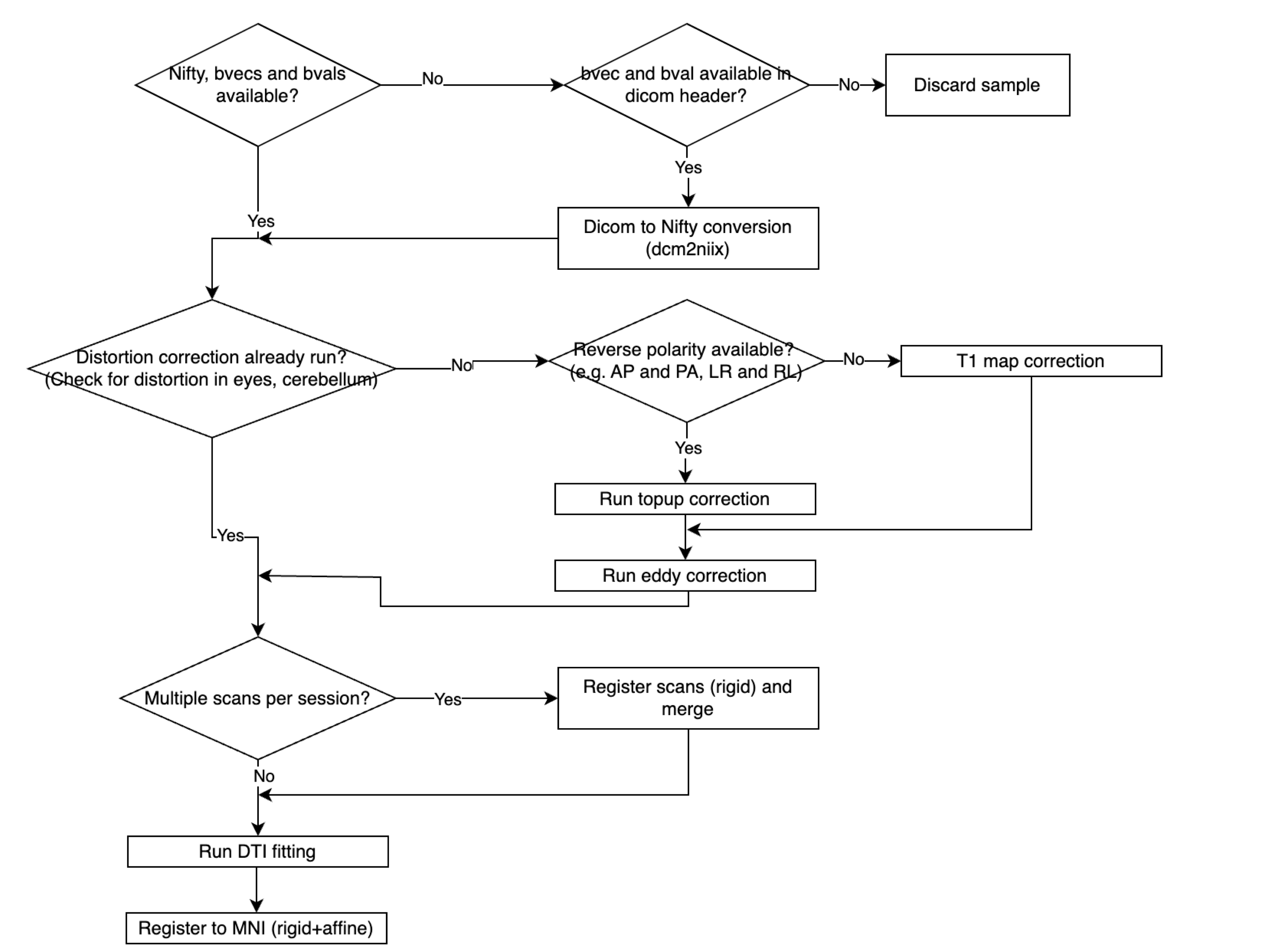
DICOM → NIfTI
-
Topup (FSL) – Correct field distortions (if AP/PA available)
-
Eddy (FSL) – Correct motion and eddy currents
-
Brain Extraction (BET) – Remove non-brain tissue
-
Merge Acquisitions – Combine split-session scans if applicable
-
DTI Model Fitting (DTIFIT) – Compute FA, MD, RD, AD maps
-
Registration to MNI (ANTs: Rigid + Affine)
-
QC – Motion metrics, gradient coverage, error maps
Outputs:
-
DTI maps (FA/MD/RD/AD) in native and/or MNI space
-
Masks, model parameters, and QC reports
Additional Notes
-
All intermediate steps are saved for each modality.
-
A flowchart is available for all pipelines. For example, DTI: